
For most of us, when a planning application is approved we assume that it is now possible to proceed with the building of our dream home or our bathroom extension, safe in the knowledge that all the really important issues have been flagged up in planning process and the conditions just need to be worked through.
However, there are an increasing number of developments and properties having to press pause on work simply because the issue of historic mining subsidence has not been considered as part of the process. This means that we are being called in to conduct a last minute assessment during construction, often thanks to a diligent Building Control officer who requests to see proof of a mining search.
When none can be produced, work has to be halted for us to come in and verify whether the land is safe for development or whether the plans need further thought. This can cause lengthy delays and unforeseen costs for homeowners and builders. In the worst cases resulting in a change or cancellation of the project after considerable time and money has been spent. So, what should the process be in instances such as these?
What Should The Planning Process Look Like For Mining Hazards?
Plans are submitted to Cornwall Council to be approved. This is generally a 12-16 week process during which time, various local bodies are informed of the request with planners scrutinising what the applicant wishes to do. We all know Cornwall is riddled with mines, the legacy of which still causes significant subsidence issues. Thus, it is imperative for a mining search to be conducted as part of this initial planning application process.
Mining Searches are a very cheap and quick way of determining whether a site is likely to be affected by mining or not. Such a search would raise any potential mining hazards and provide a chance for the applicant to carry out a more detailed mining investigation if required. This is less intrusive, straightforward and cost-efficient than any retrospective assessment. It provides peace of mind enabling the development to proceed as planned or guide way forward to resolve the issue at the earliest point so the development can stay on track and on budget.
What The Current Planning Process Looks Like For Mining Hazards
Plans are submitted to Cornwall Council to be approved, going through the routine of advising various local bodies and authorities as well as residents. Plans are then either approved or rejected without any consideration for what may lie beneath. The existence of our mining legacy is rarely flagged up as a potential problem, even in the most heavily mined areas with seemingly no consistent or reliable approach.
Approved plans then move into the construction phase where the legacy of historic mining either raises its head late, causing delays and extra cost, or remains hidden until the property is sold.
Case Study Example
One such example was a recent commercial development in Hayle. Planning was approved for the site in December 2022 and there was no condition to consider the threat of historic mining subsidence. Work began in June 2023. It became apparent during construction that there were poor ground conditions onsite so an engineer designed a reinforced slab foundation. No geotechnical or mining investigation was undertaken (none were required by planning) to clarify why the ground conditions might be poor and construction continued.
Building Control inspectors visited the site in July 2023 and asked to see proof of a Mining Search. None had been produced. Construction continued.
We, Cornwall Mining Consultants, were then called on to undertake a Mining Search to satisfy building control. Our desktop study immediately identified two recorded shafts and a suspected shallow adit, (shallow tunnel) see image below.
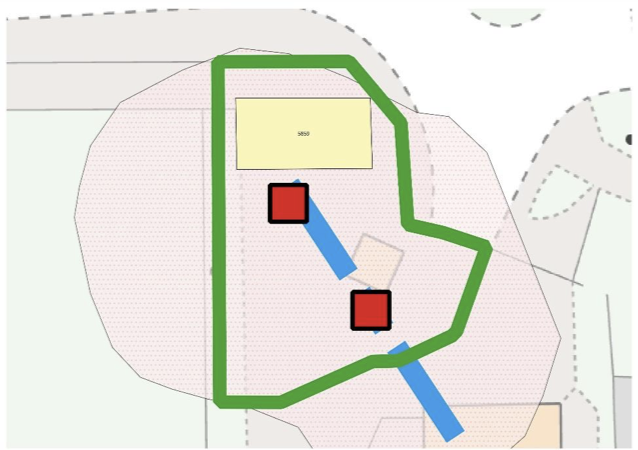
Construction was continuing so we went to meet the developer on site, by which time construction was complete with the final fitting out almost finished too. This meant that no useful evidence could be achieved from inspection so instead, we took GPS locations to reconcile the slabs with the known mining hazards.
We then examined the engineering details from the slab which showed that a worse case span of 2.5m had been allowed. We looked at third-party geotechnical data from a neighbouring site which suggested alluvial material is 5.5m thick. The cone of subsidence around a 1.5m shaft is calculated at 12.5m worst case. This meant we concluded that the slab used would not be sufficient as an effective defence against the collapse of the shaft underneath.
As construction was complete, the developer was unwilling to instigate a mining investigation at such a late stage. It would cause disruption and additional costs which they were not prepared to agree to.
In the interest of safety, we continued our research and assessment to try to find a workable way forward for the client, surmising that the shaft is lying just outside the footprint of the building and is likely to represent early trial working. We recommended a risk management strategy with continued, regular monitoring, however, we were unable to provide any assurances to protect the site or its users beyond the footprint of the building and the hazard has not been resolved for any future sale or investment.
All of this could have so very easily been avoided with the building safely constructed and the hazard resolved IF a simple mining search had been made a condition during the planning process. We are hopeful of future change but for now, we urge anyone submitting plans to use our FREE MineScanner tool to see if a mining search is required. If the answer is yes, you can order this online via the MineScanner service and we can support you in any next steps.
With 80% of properties soon cleared as safe, it’s an easily accomplished solution to what could end as a complex problem, if completely ignored.
Those searches which raise any issues, we can rectify with further investigation work, all of which is cheaper and easier to undertake before any building work begins. Try it for yourself, use our MineScanner tool and see if your property would be cleared!